

2026 Updated Verified AP-215 Downloadable Printable Exam Dumps
The Ultimate Salesforce AP-215 Dumps PDF Review
NEW QUESTION # 37
A client wants to integrate their data within Marketing Cloud Intelligence to optimize their marketing insights and cross-channel marketing activity analysis. Below are details regarding the different data sources and the number of data streams required for each source.
When harmonizing the Objective field from within the data stream mapping, which advantage is gained?
- A. Ease of Maintenance
- B. Scalability
- C. Performance (Performance when loading a dashboard page)
- D. Ease of Setup
Answer: A
Explanation:
By harmonizing the Objective field within data stream mapping, an organization can benefit from:
Ease of Maintenance: Harmonization allows for consistent naming conventions across different data sources and streams. This means when business logic or naming conventions change, updates can be made in one place and consistently applied across all data streams. It also reduces the complexity of managing multiple streams and ensures data consistency, which is vital for accurate reporting and analysis.
NEW QUESTION # 38
A client would like to integrate the following two sources:
Google Campaign Manager:
IAS:
After configuring a Parent-Child relationship between the files, which query should an implementation engineer run in order to QA the setup?
- A. Media Buy Name, Impressions
- B. Media Buy Type, Media Buy Name, Impressions, Analyzed Impressions
- C. Media Buy Type, Analyzed Impressions
- D. Creative Name, Impressions, Analyzed Impressions
Answer: B
Explanation:
To QA the Parent-Child relationship setup between Google Campaign Manager and IAS data sources, it is essential to query fields that are common to both sources and that are relevant to the relationship. 'Media Buy Type' and 'Media Buy Name' are common identifiers between the two datasets. 'Impressions' from the Google Campaign Manager and 'Analyzed Impressions' from the IAS data are the metrics that should be compared to ensure they match or correlate as expected due to the Parent-Child relationship. The QA process involves checking that the data is correctly aligned and that the metrics from the parent source (Google Campaign Manager) are properly related to the metrics from the child source (IAS). Reference: Salesforce Marketing Cloud Intelligence documentation on data integration, Parent-Child relationships, and QA procedures for data setup.
NEW QUESTION # 39
What are two potential reasons for performance issues (when loading a dashboard) when using the CRM data stream type?
- A. When a data stream type ''CRM - Leads' is created, another complementary 'CRM - Opportunity' is created automatically.
- B. Pacing - daily rows are being created for every lead and opportunity keys
- C. The data is stored at the workspace level.
- D. No mappable measurements - all measurements are calculated
Answer: B,D
Explanation:
For performance issues when loading a dashboard using CRM data stream type:
Pacing can create performance issues because daily rows for every lead and opportunity key can result in a very large number of rows, increasing load times.
Having only calculated measurements means there are no direct, mappable values to query against, which can increase the computational load and affect performance.
NEW QUESTION # 40
An Implementation engineer is requested to create a new harmonization field 'Offer' and apply the following logic:
The implementation engineer to use the Harmonization Center. Which of the below actions can help implement the new dimension 'Offer?
- A. Two separate patterns (filtered by Linkedln or AdRoll sources).
Another single pattern for Web Analytics Site Source (filtered by Google Analytics source), extracting all three positions A total of 3 patterns. - B. Two separate patterns (filtered by Linkedin or AdRoll sources)
Within Google Analytics' mapping A formula that reflects the logic above will be populated within a Web Analytics Site custom attribute Another pattern to be created for the newly Web Analytics Site custom attribute (filtered by Google Analytics source).
A total of 3 patterns. - C. Two separate patterns (filtered by Linkedin or AdRoll sources).
Another single pattern for Campaign Name (filtered by Google Analytics source).
A total of 3 patterns. - D. Two separate patterns (filtered by Linkedin or AdRoll sources)
Within Google Analytics' mapping: A formula that reflects the logic above will be populated within a Campaign custom attribute.
Another pattern to be created for the newly campaign attribute (filtered by Google Analytics source).
A total of 3 patterns
Answer: D
Explanation:
To implement the new harmonization field 'Offer', the implementation engineer would create two separate harmonization patterns for LinkedIn and AdRoll sources, extracting the 'Campaign Name' using the specified delimiter and position. Then, within Google Analytics' mapping, a custom attribute for the 'Campaign' would be created to apply the formula logic based on the source. This allows for the harmonization of campaign data across different platforms, ensuring consistency in the reporting and analysis within Marketing Cloud Intelligence. The total patterns required would be three, one for each data source involved.
NEW QUESTION # 41
A technical architect is provided with the logic and Opportunity file shown below:
The opportunity status logic is as follows:
For the opportunity stages "Interest", "Confirmed Interest" and "Registered", the status should be "Open".
For the opportunity stage "Closed", the opportunity status should be closed Otherwise, return null for the opportunity status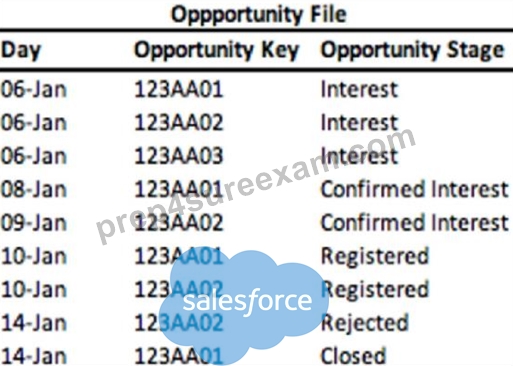
Given the above file and logic and assuming that the file is mapped in a GENERIC data stream type with the following mapping:
"Day" - Standard "Day" field
"Opportunity Key" > Main Generic Entity Key
"Opportunity Stage" - Generic Entity Key 2
"Opportunity Count" - Generic Custom Metric
A pivot table was created to present the count of opportunities in each stage. The pivot table is filtered on January (entire month). What is the number of opportunities in the Interest stage?
- A. 0
- B. 1
- C. 2
- D. 3
Answer: D
Explanation:
Based on the Opportunity file, the Opportunity Stage of 'Interest' occurs 3 times across unique Opportunity Keys. Since the pivot table is filtered to present the entire month of January and the Opportunity Stage 'Interest' is listed three times with different Opportunity Keys, the count of opportunities in the 'Interest' stage would be 3.
NEW QUESTION # 42
Which two statements are correct regarding LiteConnect?
- A. The dataset does not conform to the standard data model
- B. All of the dimensions mapped within a LiteConnect data stream are considered overarching entities.
- C. Data coming from LiteConnect cannot be harmonized with the rest of the workspace data via the harmonization center at a later step.
- D. It does not require any identification of entities, keys or any other categorization.
Answer: A,D
Explanation:
LiteConnect is a feature in Salesforce Marketing Cloud Intelligence that allows users to bring external data into the platform quickly and easily. Here are the correct statements regarding LiteConnect:
A . LiteConnect allows for a quick setup by not requiring detailed identification of entities, keys, or categorization. Users can upload files without having to conform to the standard data model, which speeds up the process of data integration.
B . With LiteConnect, datasets are uploaded in their native format and do not conform to the standard data model of Marketing Cloud Intelligence. This means that the original structure of the dataset is maintained, and there is no need for extensive transformation or mapping upon the initial data import.
For C and D: While LiteConnect datasets might not conform to the standard data model initially, there are capabilities within Marketing Cloud Intelligence to further categorize and harmonize this data if needed. Therefore, C is not entirely correct, and D is incorrect because harmonization can indeed occur at a later step.
NEW QUESTION # 43
Your client is interested in ingested the below file to a new generic data stream type:
The field 'Meeting Code' was mapped to the main entity key. 'How should the 'Room Number' be mapped?
- A. A separate entity key
- B. A custom metric and set aggregation to AUTO
- C. A custom metric and set aggregation to SUM
- D. An attribute of 'Meeting Code'
Answer: D
Explanation:
In Marketing Cloud Intelligence, when a field is mapped to the main entity key, other related fields should be mapped as attributes of that key if they provide additional descriptors or details. Since 'Room Number' is related to 'Meeting Code', it would be an attribute of the 'Meeting Code' entity, providing additional context to the meetings without serving as a metric or a separate entity key.
NEW QUESTION # 44
A client has integrated data from Facebook Ads, Twitter Ads, and Google Ads in Marketing Cloud Intelligence. For each data source, the data follows a naming convention as shown below:
Facebook Ads Naming Convention - Campaign Name:
Camp|D_CampName#Market_Objective#TargetAge_TargetGender
Twitter Ads Naming Convention - Media Buy Name:
Market|TargetAge|Objective|OrderID
' Google Ads Naming Convention - Media Buy Name:
Buying Type_Market_Objective
The client wants to harmonize their data on the common fields between these two platforms (i.e. Market and Objective) using the Harmonization 'Center.
In addition to the previous details, the client provides the following data sample:
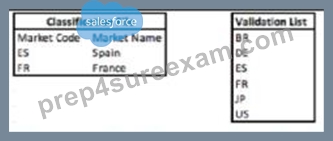
Logic specification:
If a value is not present in the Validation List, return "Not Valid"
If a value is not present in the Classification File, return "Unclassified".
If the Harmonization center is used to harmonize the above data and files, what table will show the final output?
- A.

- B.

- C.

- D.

Answer: D
Explanation:
The correct table would be Option B.
The harmonization process would identify the 'Market' from the campaign or media buy name based on the delimiter and position rules specified in the naming conventions. The harmonized 'Market' would then be matched against the classification file and validation list. If a value does not match the validation list, it would return 'Not Valid', and if it's not present in the classification file, it would return 'Unclassified'. Option B is the only table showing the 'Not Valid' category which aligns with the logic specification provided.
NEW QUESTION # 45
A client has integrated data from Facebook Ads. Twitter ads, and Google ads in marketing Cloud intelligence. For each data source, the source, the data follows a naming convensions as ...
Facebook Ads Naming Convention - Campaign Name:
CampID_CampName#Market_Object#object#targetAge_TargetGender
Twitter Ads Naming Convention- Media Buy Name
MarketTargeAgeObjectiveOrderID
Google ads Naming Convention-Media Buy Name:
Buying_type_Market_Objective
The client wants to harmonize their data on the common fields between these two platforms (i.e. Market and Objective) using the Harmonization Center. Given the above information, which statement is correct regarding the ability to implement this request?
wet Me - Given the above information, which statement i 's Correct regarding the ability to implement this request?
- A. The client will be able to do this and it will require building three patterns.
- B. The client Wi-Fi be able to harmonize only Google Ads and Twitter Ads, as Facebook Ads naming convention contains mufti delimiters.
- C. it is not possible to do this, as the naming conventions are different
- D. This is not possible as the naming conventions are in different fields (Campaign Name and Placement Name)
Answer: A
Explanation:
Despite the different naming conventions, harmonization is possible using patterns in the Harmonization Center. By extracting the 'Market' and 'Objective' components from the naming conventions of each platform, three separate patterns would be created to map these common fields consistently across the data from Facebook Ads, Twitter Ads, and Google Ads.
NEW QUESTION # 46
The following file was uploaded into Marketing Cloud Intelligence as a generic dataset type:
The mapping is as follows:
Day - Day
Web_site_source - Main Generic Entity Attribute 01
Page Views - Generic Metric 1
*Note that 'web_site_key' and 'web_site_name' are NOT mapped.
How many rows will be stored in Marketing Cloud Intelligence after the above file is ingested?
- A. 0
- B. 1
- C. 2
- D. 3
Answer: C
Explanation:
In Marketing Cloud Intelligence, when a file is uploaded as a generic dataset type and mapped accordingly, each unique combination of the mapped fields results in a separate row in the database. The file in question has been mapped with 'Day' to 'Day', 'Web_site_source' to 'Main Generic Entity Attribute 01', and 'Page Views' to 'Generic Metric 1'. The 'web_site_key' and 'web_site_name' are not mapped and thus, won't affect the row count.
Since there are 4 unique combinations of the mapped fields in the uploaded file (each day and source combination is unique), Marketing Cloud Intelligence will store 4 rows after ingestion, corresponding to each unique combination of 'Day' and 'Web_site_source'.
NEW QUESTION # 47
A client's data consists of three data sources - Facebook Ads, LinkedIn Ads and Google Campaign Manager.
Notes:
* The client is planning on adding an additional 100 Facebook Ads data streams and 50 more LinkedIn Ads data streams.
* The final volume of data in the workspace will be 5M rows
* Each data source has a naming convention and it can be assumed that any additional profile (i.e. Data Stream) from one of these sources will follow the same naming convention.
The client provided the following sample files:
Facebook Ads:

The client would like to create a new harmonization field named "Market," which will only be coming from Facebook Ads and LinkedIn Ads. The logic for
"Market" is the following:
IF Media Buy Type is equal to "TypeB" or "TypeC" or "TypeD"
Return 'Europe'
ELSE
Return 'Rest Of The World'
In order to create the harmonization field Market, the client considers using either Mapping Formula, Calculated Dimension, VLOOKUP or Patterns.
Considering maintenance and scalability, which option is recommended?
- A. Calculated Dimension
- B. Mapping Formulas
- C. Patterns
- D. vLookuP
Answer: C
Explanation:
Patterns are the best approach in this scenario because:
Scalability: Patterns are highly scalable and can easily handle the addition of 100 more Facebook Ads and 50 more LinkedIn Ads streams. You can define pattern-matching rules that automatically apply to new data streams based on the naming conventions.
Flexibility and Maintenance: Patterns allow you to maintain and adjust logic easily. Since the logic for determining "Market" is based on a defined naming convention (e.g., Media Buy Type), Patterns can handle these rules effectively without requiring manual updates or static tables.
Efficient Harmonization: Patterns automatically classify data based on defined rules, reducing the need for ongoing manual maintenance compared to approaches like VLOOKUP or Mapping Formulas, which might require frequent updates as data changes.
Why not other options?
Mapping Formulas: While Mapping Formulas work well for static mappings, they are not as scalable or maintainable when the dataset grows or changes frequently.
Calculated Dimension: This option is valid for simple logic but is less maintainable for large-scale datasets, especially when new data streams are added.
VLOOKUP: This method is manual and not scalable. It would require you to update lookup tables for each new data stream, which is inefficient given the expected growth of the data.
NEW QUESTION # 48
A client's data consists of three data streams as follows:
Data Stream A:
* The data streams should be linked together through a parent-child relationship.
* Out of the three data streams, Data Stream C is considered the source of truth for both the dimensions and measurements.
Assuming the data was ingested properly and the Parent Child was created correctly according to the client's requirements, what is the total Impressions value for Campaign Key 'CK_3'?
- A. 0
- B. 1
- C. 2
- D. N-A
Answer: C
Explanation:
Assuming that Data Stream A is set correctly with parent-child relationships:
To find the total impressions for Campaign Key 'CK_3', you would look in Data Stream A, since it contains the 'Impressions' metric.
As per the provided data, Campaign Key 'CK_3' has 100 impressions.
NEW QUESTION # 49
A technical architect is provided with the logic and Opportunity file shown below:
The opportunity status logic is as follows:
For the opportunity stages "Interest", "Confirmed Interest" and "Registered", the status should be "Open".
For the opportunity stage "Closed", the opportunity status should be closed Otherwise, return null for the opportunity status.
Given the above file and logic and assume that the file is mapped in the OPPORTUNITIES Data Stream type with the following mapping:
"Day" - "Created Date"
"Opportunity Key" + Opportunity Key
"Opportunity Stage" - Opportunity Stage
A pivot table was created to present the count of opportunities in each stage. The pivot table is filtered on Jan 11th. What is the number of 'opportunities in the Confirmed Interest stage?
- A. 0
- B. 1
- C. 2
- D. 3
Answer: B
Explanation:
pivot table is filtered on January 11th, we refer to the Opportunity file and see that there are no records for January 11th. Thus, there would be zero opportunities in the Confirmed Interest stage on that date. The Salesforce Marketing Cloud Intelligence's pivot table feature allows for the display of counts of entities based on the filtered criteria, which in this scenario would show zero since no records exist for the filtered date. Reference: Salesforce Marketing Cloud Intelligence documentation on pivot table functionalities.
NEW QUESTION # 50
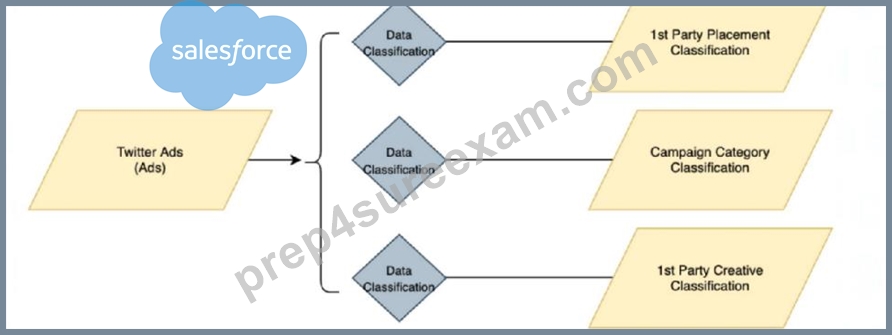
An implementation engineer has been provided with 4 different source files: 03m 48s
1. Twitter Ads ~
2. Creative Classification
3. Placement Classification
4, Campaign Category Classification
The main source is Twitter Ads (which includes various fields and KPIs), and the rest are classification files that connect to Twitter Ads and enrich different fields within it.
The connections between the files are described as follows:
1st Party Creative Classification
File structure/headers:
Creative ID - links back to Creative Key (Twitter Ads)
1st Party Placement Classification by
File structure/headers:
- A.

- B.

- C.

- D.
Answer: D
Explanation:
In Salesforce Marketing Cloud Intelligence, connections between source files and classification files are established through common keys that link data records. For this scenario:
The "1st Party Creative Classification" file has a "Creative ID" field which corresponds to the "Creative Key" in the "Twitter Ads" data. This link enables enrichment of Twitter Ads data with creative classification details.
The "1st Party Placement Classification" file will contain a "Placement ID" that connects to a corresponding field in the "Twitter Ads" data, enabling the enrichment of placement classification details.
Option A appears to accurately depict this setup where data streams for "Creative Classification" and "Placement Classification" are connected to the "Twitter Ads" data stream using the "Creative ID" and "Placement ID", respectively. This structure allows for the enhancement of the main Twitter Ads data with additional classification information.
NEW QUESTION # 51
A client provides the following two data streams:
Data Stream 1:
The client would like to use a VLOOKUP formula to calculate the Cost per Campaign Advertiser on January 1st 2020.
Which mapping options should the client apply to obtain the expected result?
- A.

- B.

- C.

- D.

Answer: B
Explanation:
To calculate Cost per Campaign Advertiser using a VLOOKUP formula, the client needs to look up the 'Cost' from Data Stream 2 based on a matching 'Media Buy Name' in Data Stream 1. Option A shows that 'Media Buy Name' is the lookup value, which is correct. The 'Campaign Advertiser' is then linked to the 'Cost' from Data Stream 2 through the VLOOKUP formula applied to the 'Media Buy Custom Attribute 01' in Data Stream 2. This setup will correctly associate the cost with the campaign advertiser.
NEW QUESTION # 52
......
Achive your Success with Latest AP-215 Exam: https://testking.prep4sureexam.com/AP-215-dumps-torrent.html