

Get Ready to Pass the D-SF-A-24 exam Right Now Using Our Dell Security Exam Package
Enhance Your Career With Available Preparation Guide for D-SF-A-24 Exam
NEW QUESTION # 10
Match the security hardening type with the hardening techniques.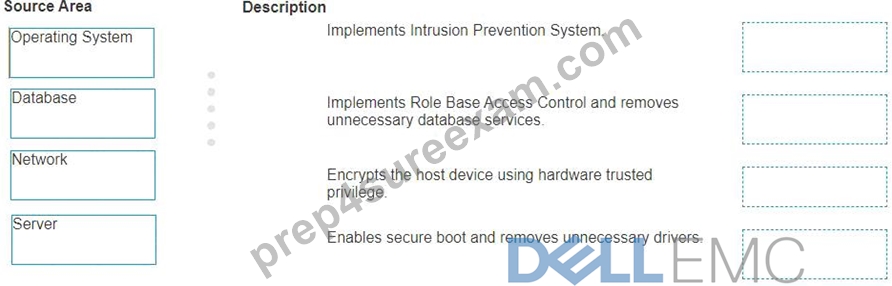
Answer:
Explanation: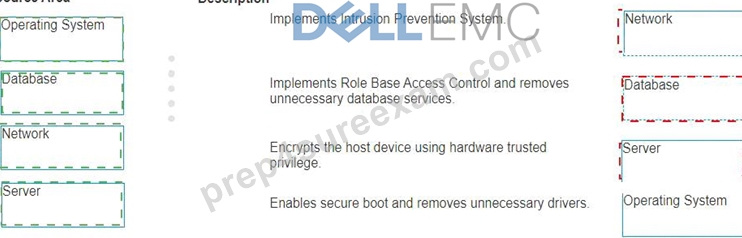
Explanation: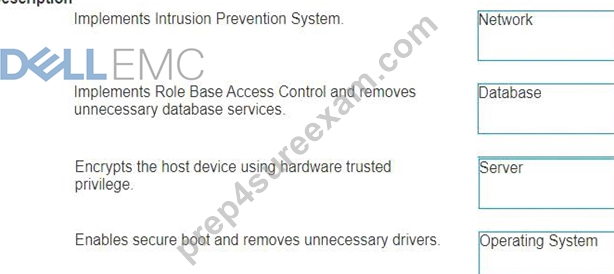
The security hardening techniques should be matched with the corresponding source area as follows:
* Operating System:Enables secure boot and removes unnecessary drivers.
* Database:Implements Role-Based Access Control and removes unnecessary database services.
* Network:Implements Intrusion Prevention System.
* Server:Encrypts the host device using hardware trusted privilege.
* Operating System Hardening:Involves enabling secure boot to ensure that only trusted software is loaded during the system startup and removing unnecessary drivers to minimize potential vulnerabilities1.
* Database Hardening:Role-Based Access Control (RBAC) restricts system access to authorized users, and removing unnecessary services reduces the attack surface1.
* Network Hardening:An Intrusion Prevention System (IPS) monitors network traffic for suspicious activity and takes action to prevent intrusions1.
* Server Hardening:Encrypting the host device using hardware-based mechanisms like Trusted Platform Module (TPM) provides a secure environment for the server's operating system1.
These matches are based on standard security practices that align with the Dell Security Foundations Achievement's emphasis on security hardening across different areas of IT infrastructure1.
NEW QUESTION # 11
During analysis, the Dell Services team found outdated applications and operating systems with missing security patches. To avert potential cyberattacks, Dell recommends application and operating system hardening measures.
Why is security hardening important for A.R.T.I.E .?
- A. Enhance operational cost.
- B. Remove redundancy.
- C. Enhance productivity.
- D. Decrease attack surface.
Answer: D
Explanation:
* Security Hardening Definition:Security hardening involves implementing measures to reduce vulnerabilities in applications and operating systems1.
* Reducing Attack Surface:By updating and patching outdated applications and operating systems,A
.R.T.I.E.can minimize the number of potential entry points for attackers1.
* Preventing Cyberattacks:Hardening is a proactive measure to protect against potential cyberattacks by eliminating as many security risks as possible1.
* Compliance with Best Practices:Security hardening aligns with industry best practices and regulatory requirements, which is essential forA .R.T.I.E.'s operations in the public cloud1.
* Dell's Recommendation:Dell's Security Foundations Achievement emphasizes the importance of security hardening as a fundamental aspect of an organization's cybersecurity strategy1.
Security hardening is crucial forA .R.T.I.E.because it directly contributes to the robustness of their cybersecurity posture, ensuring that their systems are less susceptible to attacks and breaches1.
NEW QUESTION # 12
In the cloud, there are numerous configuration options for the services provided. If not properly set, these configurations can leave the environment in an unsecure state where an attacker can read and modify the transmitted data packets and send their own requests to the client.
Which types of attack enable an attacker to read and modify the transmitted data packets and send their own requests to the client?
- A. TCP hijacking
- B. Dumpster diving
- C. Shared technology
- D. Data loss
Answer: A
Explanation:
Verified answer:The type of attack that enables an attacker to read and modify the transmitted data packets and send their own requests to the client is:C. TCP hijacking
* TCP Hijacking Definition:TCP hijacking is a type of cyber attack where an attacker takes control of a communication session between two entities12.
* Attack Mechanism:The attacker intercepts and manipulates data packets being sent over the network, allowing them to read, modify, and insert their own packets into the communication stream1.
* Impact on Security:This attack can lead to unauthorized access to sensitive data and systems, and it can
* be used to impersonate the victim, resulting in data breaches and other security incidents1.
* Prevention Measures:Implementing security measures such as encryption, using secure protocols, and monitoring network traffic can help prevent TCP hijacking attacks1.
TCP hijacking is particularly relevant to cloud environments where misconfigurations can leave systems vulnerable. It is crucial forA .R.T.I.E.to ensure proper security configurations and adopt measures to protect against such attacks as part of their migration to the public cloud and overall cybersecurity strategy12.
NEW QUESTION # 13
AnA .R.T.I.E.employee received an email with an invoice that looks official for $200 for a one-year subscription. It clearly states: "Please do not reply to this email," but provides a Help and Contact button along with a phone number.
What is the type of risk if the employee clicks the Help and Contact button?
- A. Strategic
- B. Technology
- C. People
- D. Operational
Answer: C
Explanation:
* People Risk Definition:People risk involves the potential for human error or intentional actions that can lead to security incidents1.
* Phishing and Social Engineering:The scenario described is typical of phishing, where attackers use seemingly official communications to trick individuals into revealing sensitive information or accessing malicious links1.
* Employee Actions:Clicking on the button could potentially lead to the employee inadvertently providing access to the company's systems or revealing personal or company information1.
* Dell's Security Foundations Achievement:Dell's Security Foundations Achievement emphasizes the importance of recognizing and minimizing phishing exploits as part of managing people risk21.
* Mitigation Measures:Training employees to recognize and respond appropriately to phishing attempts is a key strategy in mitigating people risk1.
In this context, the risk is categorized as 'people' because it directly involves the potential actions of an individual employee that could compromise security1.
NEW QUESTION # 14
A Zero Trust security strategy is defined by which of the primary approaches?
- A. Micro-segmenting and Multi-factor authentication
- B. IAM and security awareness training
- C. Network segmenting and access control
- D. VPNs and IAM
Answer: A
Explanation:
Topic 1, Case Study Scenario
It is recommended that you read through the case study before answering any questions. You can always return to the case study while viewing any of the twenty questions.
Introduction
As the threat landscape has grown over past years and continues to evolve unpredictably, cyber-attacks on organizations are now unavoidable. Security is no longer about averting attacks; it is all about preparing for them.
In recent years, large corporate data breaches have impacted millions of customers and revealed personal information that can be used in follow-on crimes. The longer a cyber-attack goes unnoticed, the more damage it does to the business and the more money and time it will cost to recover.
Hackers steal financial, medical, and other sensitive information to sell online or use in cybercrimes. This unpredictable security threat landscape has resulted in a challenging scenario for all organizations.
Business Description
A:R.T.I.E.is a midsize social media company whose key customers are 18- to 28-year-olds. Using the organization's platform, customers can share content such as photos, videos and post status updates and views.
The organization has a in-built messenger app that helps users to interact. The platform also has an option to make in-app purchases and play games with other users.
One key characteristic ofA .R.T.I.E.is that it supports social influencers and has attracted large firms as advertisers.
With 450 employees, who work from different locations, the main goal ofA .R.T.I.E.is to provide high quality of services to a user base of 15K individuals and associates. The employees have access to the apps, platform, data, and systems through an internal network that uses a virtual private network (VPN) to secure access from remote locations.
Business Problem
Senior management ofA .R.T.I.E.expects the core business to continue to grow rapidly due to an increase in user traffic and increased demand of its advertising platform especially by big organizations.
Based on their current business-critical needs for their solutions and client base, the organization is planning to move towards a global operational geography and have migrated some of its key applications to the public cloud. Deployment of the applications to the public cloud provides:
. Ability to scale.
. Higher data transfer speeds and more efficient access management.
. Faster time-to-market and better control of IT costs.
However, with progress comes new challenges as public cloud environments broaden the attack surface from which attackers can try to gain unauthorized access to an organization's resources.A .R.T.I.E.also must comply with various regulations and cloud security controls and have to come up with holistic security capabilities that ensure security across the organization, core-to-edge-to-cloud.
Even though the IT team of the organization constantly monitor their IT environment and assets along with watching for unauthorized profiles, information disclosure, fake accounts, and other threats, the CIO of A.R.I.T.E. is aware that the nature of their business being an open platform makes them a prime target for attackers and other cybercriminals.
Due to the growing business and untrained employees, the organization is constantly under the fear of threat.
This fear increased tenfold when they had discovered two back-to-back cyberattacks resulting in unauthorized access to databases containing user information.
In the first attack, the attackers performed data theft techniques to exfiltrate vulnerable information and held internal systems for ransom. This incident led to the company negotiating a ransom payment to recover data.
Also, an unexplained surge in requests to a single webpage occurred along with unusual network traffic patterns which indicated a second attack. These attacks were concerning not only for the financial impact but also for the amount of data exposed.
Requirements
The key requirements to address the primary challenges to the business includes:
. Understanding the cyber threat landscape specific to the organizational risk tolerance.
. Secure migration of applications to the public cloud.
. Implement a suitable security framework to tackle current and emerging threats.
. Identify possible vulnerabilities and threats.
. Create an incident management plan based on knowledge, experience, and real-time information to prevent future attacks.
. Learn about the tools and technologies used to avert the attacks and determine which tools will be appropriate for them.
. Take measures to implement secure solutions and control: Zero Trust, Security hardening, IAM techniques.
Dell Services Team
To improve the overall cyber security posture and implement better security policies as the company grows,A.R.T.I.E.contacted Dell Services.
Dell clients use their services and solutions to collectively monitor thousands of devices, systems, and applications. Some clients have a significant workforce with minimal IT knowledge, which opens greater security risks and technological gaps.
Strategic advisory team
. Commonly known as the core security team which has a global presence.
. Helps organizations to evaluate and gauge their exposure to cybersecurity risk.
. Supports various organizations in developing a vision and strategy for handling cyberattacks.
. Provides advice on the implementation of standard cybersecurity frameworks.
Ethical hackers
. Works within the defined boundaries to legally infiltrate the organization's network environment with their permission.
. Exposes vulnerabilities in customers IT systems.
Threat intelligence and incident management team
. The team help to keep the organization apprised of the latest developments in the security landscape.
. The cyber security intelligence team investigates methodologies and technologies to help organizations detect, understand, and deflect advanced cybersecurity threats and attacks on their IT infrastructure, and in the cloud.
. The incident management team helps consider what they would do when under attack. The team may simulate an attack to ensure that non-technical staff members know how to respond.
. The simulated attack is managed by the incident management team. This team also helps to prevent future attacks based on the information gathered.
Identity and Access Management team
. Reviews and accesses the access rights for each member and user.
. During their analysis the Dell cyber team did a thorough analysis to help create a secure environment for A.R.T.I.E.and mitigate potential attacks.
Outcomes
With the rapid and thorough analysis of security events originating from both internal and external sources to A.R.T.I.E.complete, the Dell Services team could detect anomalies, uncover advanced threats and remove false positives. The Threat Intelligence team was also able to provide a list of potentially malicious IP addresses, malware, and threat actors.
Along with this, the team also implemented methods that helped determine what is being attacked and how to stop an attack providingA .R.T.I.E.with real time threat detection mechanisms, knowledge on cyber security.
The common outcomes after implementation of the Dell recommendations were:
. Prioritization of threat and impact - Determine threat intelligence, vulnerability status and network communications to evaluate accurate vulnerability risk.
. Secure workforce and educate employees about best practices to be adopted to mitigate attacks, security frameworks and policies.
. Implementation of incident management plan and build an organization-wide security strategy to avert future attacks.
. Identification of at-risk users and authorized users, account takeover, disgruntled employees, malware actions.
. Streamlining of security solutions while reducing operational costs and staffing requirements.
. Increased effectiveness to address the continual growth of IT environments, along with the sharp rise in the number of threats and attacks.
The objective was to consolidate data from the organization's multiple sources such as: networks, servers, databases, applications, and so on; thus, supports centralized monitoring.
NEW QUESTION # 15
Dell Services team cannot eliminate all risks, but they can continually evaluate the resilience and preparedness ofA .R.T.I.E.by using the National Institute of Standards and Technology Cybersecurity Framework (NIST CSF).
Match the core NIST CSF component functions with the description that the Dell Services team would have recommended toA .R.T.I.E.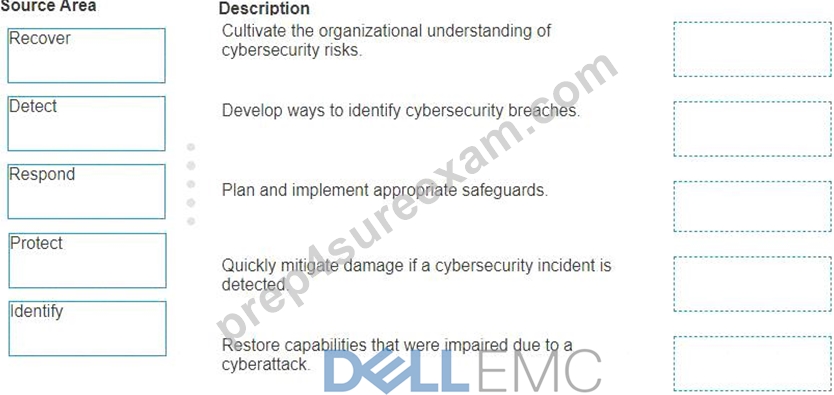
Answer:
Explanation: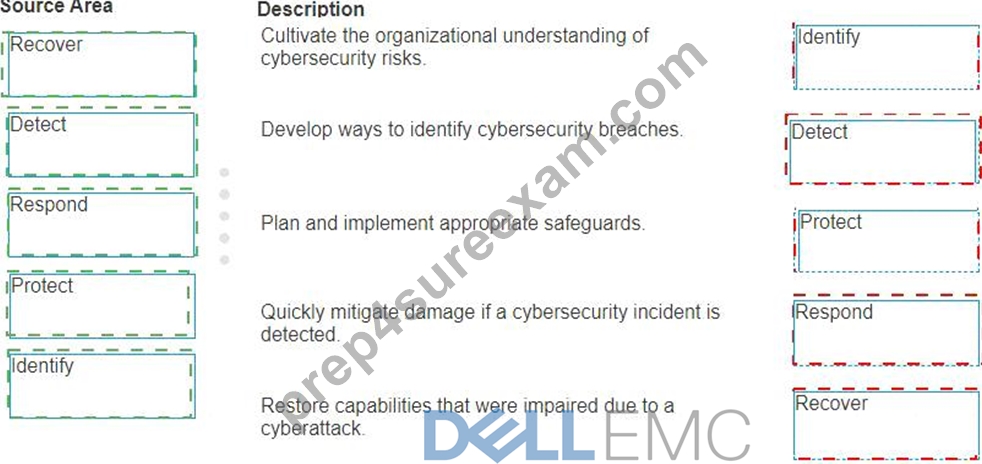
Explanation: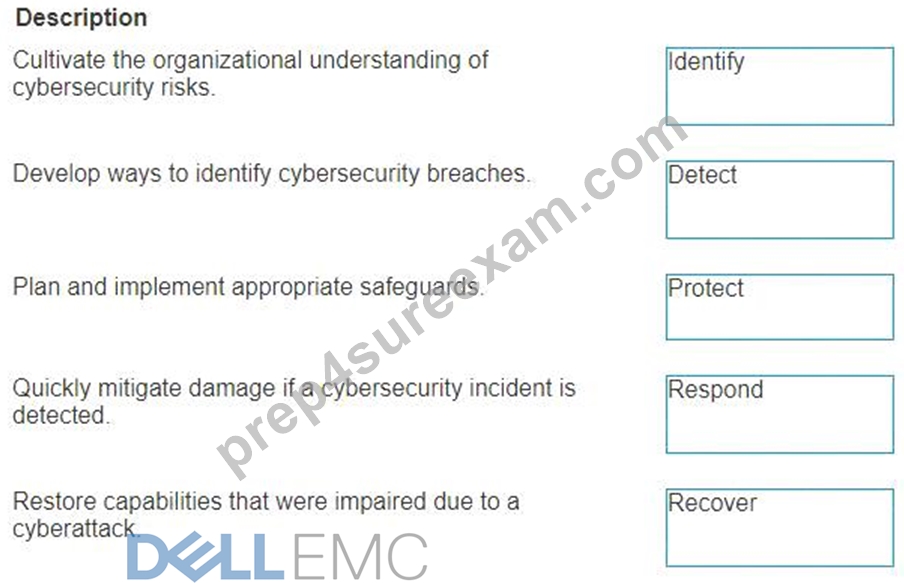
Based on the Dell Security Foundations Achievement and the NIST Cybersecurity Framework (CSF), the core NIST CSF component functions can be matched with the descriptions as follows:
* Identify:Cultivate the organizational understanding of cybersecurity risks.
* Protect:Plan and implement appropriate safeguards.
* Detect:Develop ways to identify cybersecurity breaches.
* Respond:Quickly mitigate damage if a cybersecurity incident is detected.
* Recover:Restore capabilities that were impaired due to a cyberattack12345.
* Identify Function:Involves understanding the business context, the resources that support critical functions, and the related cybersecurity risks3.
* Protect Function:Includes the appropriate safeguards to ensure delivery of critical infrastructure services4.
* Detect Function:Defines the appropriate activities to identify the occurrence of a cybersecurity event4.
* Respond Function:Includes the appropriate activities to take action regarding a detected cybersecurity event4.
* Recover Function:Identifies appropriate activities to maintain plans for resilience and to restore any capabilities or services that were impaired due to a cybersecurity event4.
These functions are integral to the NIST CSF and provide a high-level strategic view of the lifecycle of an organization's management of cybersecurity risk12345.The Dell Security Foundations Achievement documents would likely align with these functions, emphasizing their importance in a comprehensive cybersecurity strategy12.
NEW QUESTION # 16
The cybersecurity team performed a quantitative risk analysis onA .R.T.I.E.'s IT systems during the risk management process.
What is the focus of a quantitative risk analysis?
- A. Objective and mathematical models to provide risk acumens.
- B. Evaluators discretion for resources.
- C. Knowledge and experience to determine risk likelihood.
- D. Rank and handle risk to use time and resources more wisely.
Answer: A
Explanation:
Quantitative risk analysis in cybersecurity is a method that uses objective and mathematical models to assess and understand the potential impact of risks. It involves assigning numerical values to the likelihood of a threat occurring, the potential impact of the threat, and the cost of mitigating the risk. This approach allows for a more precise measurement of risk, which can then be used to make informed decisions about where to allocate resources and how to prioritize security measures.
The focus of a quantitative risk analysis is to provide risk acumens, which are insights into the level of risk associated with different threats. This is achieved by calculating the potential loss in terms of monetary value and the probability of occurrence. The result is a risk score that can be compared across different threats, enabling an organization to prioritize its responses and resource allocation.
For example, if a particular vulnerability in the IT system has a high likelihood of being exploited and the potential impact is significant, the quantitative risk analysis would assign a high-riskscore to this vulnerability.
This would signal to the organization that they need to address this issue promptly.
Quantitative risk analysis is particularly useful in scenarios where organizations need to justify security investments or when making decisions about risk management strategies. It provides a clear and objective way to communicate the potential impact of risks to stakeholders.
In the context of the Dell Security Foundations Achievement, understanding the principles of quantitative risk analysis is crucial for IT staff and application administrators.It aligns with the topics covered in the assessment, such as security hardening, identity and access management, and security in the cloud, which are all areas where risk analysis plays a key role123.
NEW QUESTION # 17
The cybersecurity team created a detailed security incident management procedures training program to manage any probable incidents atA .R.T.I.E.
Arrange the steps in the proper sequence to best manage cybersecurity incidents.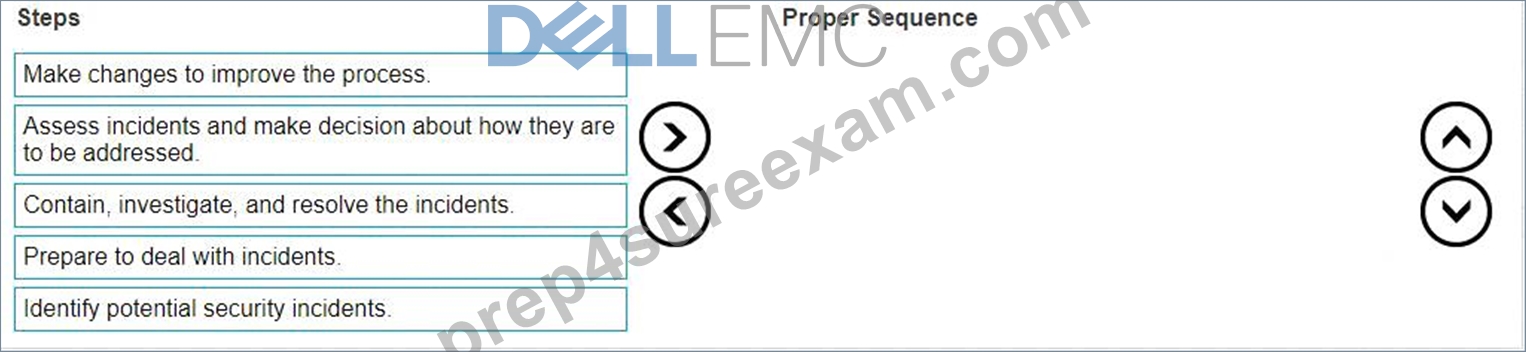
Answer:
Explanation: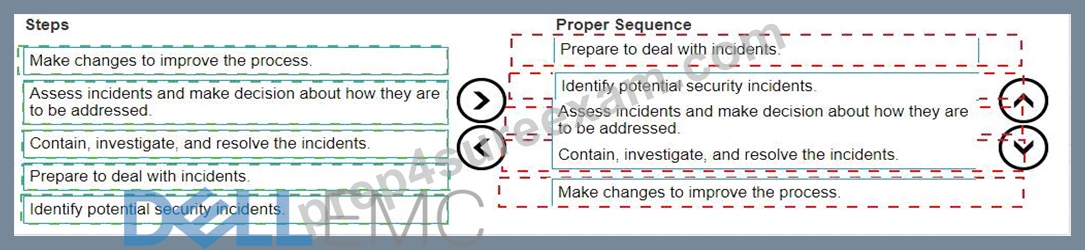
Explanation: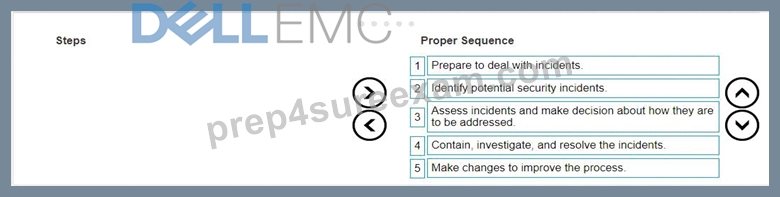
To best manage cybersecurity incidents atA .R.T.I.E., the steps should be arranged in the following sequence:
* Prepare to deal with incidents:Establish a robust incident response plan, including policies, procedures, and an incident response team.
* Identify potential security incidents:Use monitoring tools and techniques to detect anomalies that may indicate security incidents.
* Assess incidents and make decisions about how they are to be addressed:Evaluate the severity of the incident and decide on the appropriate response actions.
* Contain, investigate, and resolve the incidents:Take immediate action to contain the incident, investigate its cause, and resolve any issues to restore normal operations.
* Make changes to improve the process:After an incident, review the response process and make necessary changes to prevent future incidents and improve response strategies.
This sequence aligns with the best practices for incident management, ensuring thatA .R.T.I.E.is prepared for, can quickly respond to, and recover from cybersecurity incidents while continuously improving their security posture.The Dell Security Foundations Achievement documents would likely support this structured approach to managing cybersecurity incidents1.
NEW QUESTION # 18
......
EMC D-SF-A-24 Exam Syllabus Topics:
| Topic | Details |
|---|---|
| Topic 1 |
|
| Topic 2 |
|
| Topic 3 |
|
| Topic 4 |
|
| Topic 5 |
|
| Topic 6 |
|
Get Special Discount Offer of D-SF-A-24 Certification Exam Sample Questions and Answers: https://testking.prep4sureexam.com/D-SF-A-24-dumps-torrent.html